
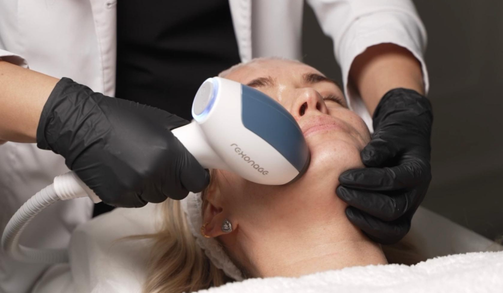
QMR Rexonage3
Geneviv’s skin and tissue protocols harness regenerative science to restore structure, stimulate collagen, and enhance cellular health. Clinical evidence demonstrates measurable improvements in skin elasticity, tissue repair, and overall skin vitality.
CLINICAL RELEVANCE
Quantum Molecular Resonance (QMR) has been investigated for its effects on cellular signalling, tissue regeneration, inflammatory modulation, and collagen remodelling – biological processes closely linked to skin quality, elasticity, wound healing, and structural ageing. Current evidence suggests QMR may support regenerative activity through low-intensity, non-thermal energy delivery capable of influencing cellular behaviour without inducing significant tissue damage. Across preclinical and clinical studies, these effects have been associated with improvements in dermal organisation, collagen architecture, inflammatory balance, tissue recovery, and regenerative coordination in ageing, damaged, or inflamed skin environments.
REFERENCES:
1. Decellularised esophageal tubular scaffold microperforated by quantum molecular resonance technology and seeded with mesenchymal stromal cells for tissue engineering esophageal regeneration
Marzaro et al, Bioengineering and Biotechnology (2022)
DOI: https://doi.org/10.3389/fbioe.2022.912617
Key Findings:
Microperforated decellularised oesophageal scaffolds seeded with mesenchymal stromal cells demonstrated physiologically organised tissue regeneration following QMR exposure. Regenerated tissue showed preservation of multilayer structural organisation, biomechanical integrity, collagen composition, muscle fibre architecture, and tissue thickness comparable to native oesophageal tissue. Findings support the role of QMR in coordinated structural regeneration rather than non-specific tissue repair, demonstrating restoration of tissue architecture and biological function.
“Full-thickness regeneration of the esopheageal wall, resembling the native organ”
2. In-vitro analysis of Quantum Molecular Resonance effects on human mesenchymal stromal cells.
Stella et al, Public Library of Science (2018)
DOI: https://doi.org/10.1371/journal.pone.0190082
Key Findings:
Quantum Molecular Resonance demonstrated regenerative effects on human mesenchymal stromal cells, supporting cellular viability, proliferation, and regenerative organisation under inflammatory and acidic conditions associated with impaired healing environments. Cells maintained structural and functional consistency during regeneration, suggesting controlled regenerative modulation rather than nonspecific proliferative activity, with relevance to ageing tissue and impaired skin recovery.
“QMR treatment maintained the viability of human mesenchymal stromal cells”
3. Quantum Molecular Resonance ameliorates atopic dermatitis through suppression of IL-36G and SPRR2B
Kim et al, Biochemistry & Molecular Biochemistry (2025)
DOI: https://doi.org/10.5483/BMBRep.2024-0105
Key Findings:
In preclinical models of atopic dermatitis, QMR was associated with downregulation of inflammatory mediators linked to skin barrier dysfunction and chronic inflammatory signalling, including IL-36G and SPRR2B expression. Findings suggested modulation of inflammatory pathways involved in epidermal homeostasis, immune dysregulation, and inflammatory signalling associated with chronic skin inflammation.
“QMR ameliorated atopic dermatitis through suppression of IL-36G and SPRR2B”
Improvement of skin firmness and reduction of striae distensae with an energy-based device using quantum molecular resonance
Cho and Kim, Journal of Cosmetic Dermatology (2023)
DOI: https://doi.org/10.1111/jocd.15915
Key Findings:
Clinical application of QMR-based treatment protocols demonstrated improvements in dermal firmness and reduction in the appearance of striae distensae. Observed effects were associated with increased expression of growth factors involved in extracellular matrix regulation, collagen organisation, dermal structural support, and skin elasticity, supporting its application in skin laxity and structural dermal ageing.
“Improvement of skin firmness and reduction of striae distensae”
5. Treatment for Aging Skin with Multifrequency Radiofrequency
Baek et al, Dermatologic Therapy (2023)
DOI: https://doi.org/10.1155/2023/7551039
Key Findings:
Multifrequency radiofrequency (MFRF) delivered through QMR demonstrated improvements in visible signs of skin ageing through increased collagen bundle density and elastic fibre organisation within the dermis. Histological analysis identified increased expression of both type I and type III collagen – the latter associated with newly synthesised, more youthful collagen architecture – alongside improvements in skin firmness, elasticity, and wrinkling, achieved with lower inflammatory activity compared to conventional thermal-based technologies.
“Type I and Type III collagen and elastic fibres increased after treatment”
6. Quantum Molecular Resonance technology in hard-to-treat extremity wounds: histological and clinical results
Fraccalvieri et al, Journal of Cosmetic Dermatology (2017)
DOI: https://doi.org/10.1111/iwj.12805
Key Findings:
In difficult-to-heal wound environments, QMR demonstrated improved tissue healing dynamics, including reductions in inflammation and oedema alongside increased angiogenesis, microvascularisation, and re-epithelialisation. Histological findings supported enhanced regenerative activity and tissue organisation within compromised tissue environments, suggesting improved regenerative coordination during wound recovery.
“An increase of angiogenesis and re-epitheliazation processes were observed”
7. Use of quantum molecular resonance energy for managing postrhinoseptoplasty perilesional edema and ecchymosis
Ahn et al, Journal of Cosmetic Dermatology (2021)
DOI: https://doi.org/10.1111/jocd.14628
KEY FINDINGS:
QMR delivers non-ionising high-frequency waves (4-64 MHz) at low intensity, capable of influencing molecular and cellular activity without generating significant thermal tissue damage. The study discussed effects on cellular viability, proliferation, migration, inflammatory signalling, neovascularisation, and extracellular matrix production within post-surgical tissue environments. Clinical use following rhinoseptoplasty demonstrated benefits in oedema and ecchymosis management during tissue recovery, supporting regenerative healing with reduced inflammatory burden.
“QMR can break molecular bonds without generating thermal damage”
The research and studies presented on this page are provided for educational purposes and reflect current scientific findings. Individual responses to treatments may vary, and results cannot be guaranteed. At Geneviv Clinic, all thereapies are personalised, guided by clinical assessment, and aligned with your unique health, lifestyle, and goals. This information is not a substitue for professional medical advice, diagnosis, or treatment. For guidance specific to you, we invite you to book a consultation with our expert clinical team in London, Belgravia. Last updated: April 2026